Ordering custom acetate hair claw clips is different from buying stock. You're commissioning a product — your shape, your colors, your logo, your packaging — and the difference between a smooth project and a painful one comes down to how well you understand the process before you start. This guide walks through the whole OEM/ODM journey so you know what to expect, what to ask for, and what actually costs money.
OEM vs ODM: Pick Your Starting Point
Two paths lead to a custom product, and the one you choose changes the timeline and the cost.
- OEM (Original Equipment Manufacturing) — you bring the design or existing sample; we produce it to your specification. You already have a product or a clear technical drawing, and you need a factory to make it.
- ODM (Original Design Manufacturing) — you bring the idea or a reference; our in-house designers develop the product. Best when you have a vision but no technical file — we handle shape design, material selection, and engineering.
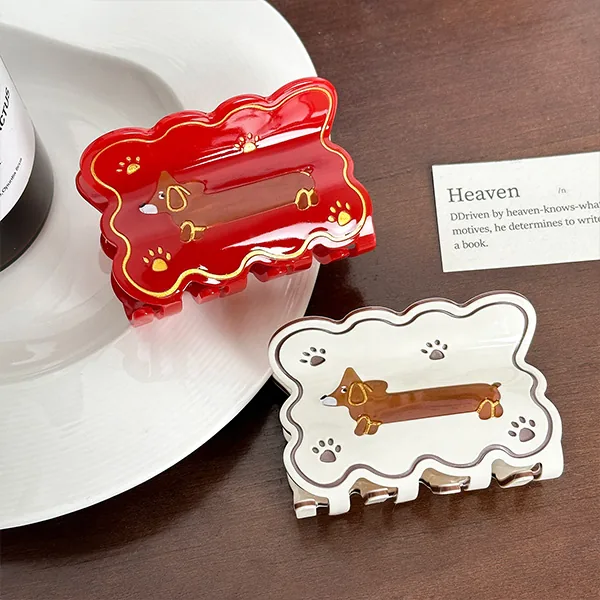
Most of our custom projects start somewhere between the two: a buyer sends photos of a clip they like plus their own logo, and our five senior designers turn it into production-ready engraving files. You can see how that cooperation works in detail on our OEM/ODM service page.
What You Can Customize (and What You Can't)
Acetate clips are cut from sheets and finished by hand, so customization follows the material's logic. Here's the realistic menu:
| Customization | Options | Cost impact |
|---|---|---|
| Shape / silhouette | Any cuttable outline; CNC engraving from your drawing or ours | Engraving file fee (one-time) |
| Material & color | Acetate sheets in solid, tortoiseshell, marble, two-tone; or acrylic for budget lines | Material grade premium |
| Logo / branding | Engraving with paint, silk screen, pad printing, UV printing, hot stamping, metal logo plates, metal transfer stickers | Depends on method & qty |
| Hardware | Spring type & tension, hinge finish (nickel, gold, antique) | Minor |
| Packaging | Polybag, hang tag, branded gift box, custom carton labels, eco kraft | Varies by material |
What you can't easily do: injection-molded details (that's a different manufacturing process entirely), or ultra-thin profiles that would compromise spring strength. A good factory tells you this up front instead of over-promising.
The 6-Step Custom Project Timeline
- Inquiry & brief — share your idea, reference images, target price and quantity. We confirm feasibility within 24 hours.
- Design & engraving files — our team prepares the bill of materials and CNC engraving files. For OEM, we work from your files; for ODM, we design from scratch.
- Sampling — precise engraving, hand polishing, shaping and assembly. Samples ready in 7-15 days.
- Sample approval — you review the physical sample, request tweaks if needed, and approve before bulk production starts.
- Bulk production — 20-35 days depending on quantity and process complexity, with in-line QC at every stage.
- Final inspection & shipping — AQL 2.5 random sampling, custom packaging, and worldwide shipping with full export documentation.
Logo Methods: Which One Fits Your Brand
Your logo is where most of the branding decisions happen. Here's the honest comparison:
- Engraving with paint — the classic premium look. The logo is carved into the acetate and filled with color. Best for elegant, long-term branding.
- Silk screen / pad printing — printed on the surface. Cheaper, great for complex multi-color logos, but more exposed to wear.
- UV printing — high-detail and photo-realistic prints, ideal for intricate artwork.
- Hot stamping — metallic foil effect for a luxe finish.
- Metal logo plates / transfer stickers — a separate metal or sticker element, often used on premium collections (like our rhinestone-accented styles).
Not sure which to pick? Send us your logo and a product idea — we'll recommend a method based on material, size and budget. If you're still exploring styles, browsing our existing claw clip designs gives you a fast starting point.
MOQ, Sampling and Cost Reality
Custom work costs more than stock — that's the trade for owning the product. Three numbers matter:
- MOQ: we start at 120 pieces per design. That's deliberately low, because acetate is sheet-cut and hand-finished; we'd rather help you test a design than force a 1,000-piece gamble.
- Sample cost: paid once per design, refundable against your bulk order in most cases. Confirm this in writing before paying.
- Engraving / mold cost: a one-time fee for the engraving file and any tooling. It's yours afterward — reorder any time without paying again.
A full breakdown of how sourcing economics work — including why MOQs and lead times look the way they do — is in our wholesale supplier checklist.
Quality and Compliance for Custom Orders
Custom products still have to pass the same safety gates as anything else you sell. For hair accessories going to the US and EU, that means knowing your material compliance: our acetate materials carry a California Proposition 65 test report (CA Prop 65), EN 71 certification, and CE compliance among others, plus GRS certification for recycled acetate on request. EU buyers may also want REACH documentation for regulated substances. Ask your factory for the test reports that match your target market — a custom order is exactly when you don't want surprises at customs.
If you're new to the material itself, our acetate material guide explains what cellulose acetate is and why it's the premium choice — useful background before you commit to a material spec.
How to Brief a Factory So You Get What You Want
A good brief saves a round of samples. Include: target quantity and price range, reference images (or a physical sample), your logo file (vector preferred), the logo method you lean toward, packaging needs, and your target market — because that drives compliance requirements. Ambiguity is expensive; a factory will build to whatever it's given.
Packaging and Private-Label Considerations
Custom orders usually mean private-label, and private-label means packaging decisions. The simplest option is a plain polybag — fine for budget lines and drop-shipping. Most brands, though, want at least a hang tag that carries the logo, and premium collections often use a branded gift box with a custom insert. Your carton labels and shipping marks also carry your brand name and barcode, which matters if you're selling through retailers that scan goods at receiving.
One practical tip: send us your packaging mock-up or reference photo at the brief stage, not after production starts. Packaging affects the box dimensions, which affects shipping cost per unit, which affects your margin. We prepare a packaging mock-up before production so there are no surprises at the pallet level. Eco-friendly kraft options are available if sustainability is part of your brand story — a growing number of our buyers ask for them specifically.
How to Pick the Right Factory for Your Custom Project
Not every factory is set up for custom acetate work. Before you commit, check that your candidate has: in-house designers (so your idea actually becomes a manufacturable file), sheet-cutting capability (not just injection molding), experience with your logo method, and a sample policy that doesn't hold you hostage. For a broader view of how suppliers compare on these points, see our roundup of top acetate claw clip manufacturers.
Start Your Custom Acetate Project
Send your idea, reference photos or logo — our design team replies within 24 hours.
Get a Quote